
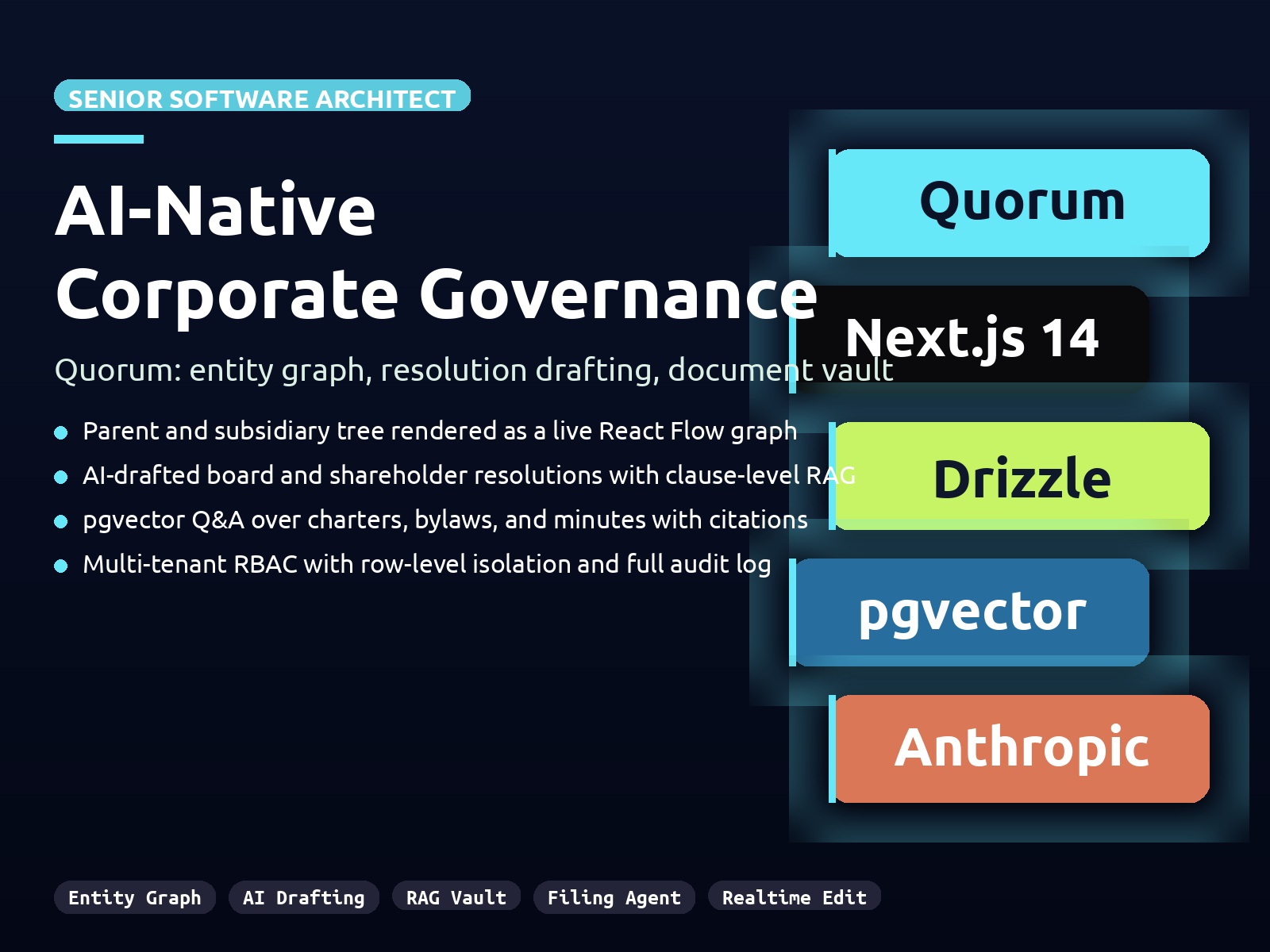
Quorum
AI-native corporate governance: entity graph, AI-drafted resolutions, RAG over corporate documents, agentic filing prep, realtime collaborative editing.
The problem
In-house counsel and entity administrators still run corporate governance out of shared drives, Word templates, and a calendar reminder for each annual filing. Resolutions get drafted from a folder of past resolutions that someone has to remember the name of. Subsidiary ownership lives in a spreadsheet nobody trusts, and filing prep is a manual checklist exercise.
Goals
- Render parent and subsidiary ownership as a live graph rather than a spreadsheet
- Draft board and shareholder resolutions from a natural-language prompt with clause-level retrieval over past resolutions
- Search and ask questions across charters, bylaws, stockholder agreements, and minutes with citations
- Run a filing-prep agent that assembles packets and pauses at a human-in-the-loop approval gate
- Enforce tenant isolation at the database row level with admin, officer, counsel, and viewer roles
The solution
- Next.js 14 app with NextAuth, multi-tenant Postgres rows, and Drizzle ORM for the entity, document, and resolution models
- Entity graph CRUD with React Flow plus Dagre auto-layout for the ownership and officer tree
- AI resolution drafting backed by Anthropic and OpenAI with a template library and clause-level RAG over past resolutions
- Document vault with pgvector embeddings, hybrid retrieval, and answer citations linking back to the source paragraph
- Realtime collaborative editor with multi-cursor presence and inline comments so counsel can redline live
- Filing-prep agent that reads entity state, gathers uploads, assembles a packet, and pauses for approval before completion
- Audit log on every state change and Langfuse traces on every model run
My role
- → Solo architect and engineer, requirements to deploy
- → Data model for entities, officers, share ledger, resolutions, documents, and the audit log in Drizzle + Postgres
- → Entity graph visualization wired to React Flow with Dagre layout and per-node detail panels
- → AI drafting pipeline: clause-level retrieval over past resolutions, template library, model selection between Anthropic and OpenAI
- → RAG vault: pgvector embeddings, chunking strategy, hybrid retrieval, citation rendering
- → Filing-prep agent with explicit human-in-the-loop checkpoint
UI direction
A counsel-facing app that looks like a modern SaaS rather than a legal tool. Tailwind, calm dark and light themes, the entity graph as the centerpiece, and a chat-style draft surface for resolutions that always shows where each clause came from.
User flows
Draft a board resolution
- 1 Counsel opens the entity, clicks New Resolution
- 2 Types a natural-language prompt (e.g. approve a subsidiary capital injection)
- 3 System retrieves clause-level matches from past resolutions in the vault
- 4 Anthropic or OpenAI drafts the resolution with the matched clauses inline as citations
- 5 Counsel edits in the realtime editor, redlines with co-counsel, and saves a final version into the vault
Ask the vault
- 1 User opens the document Q&A panel
- 2 Types a question like what does the stockholder agreement say about pre-emption rights
- 3 pgvector retrieval pulls the top passages across charters, bylaws, agreements, and minutes
- 4 The answer renders with paragraph-level citations linking back to the source document
Filing-prep agent
- 1 Compliance calendar surfaces an upcoming filing deadline
- 2 Agent reads the entity state and gathers the required documents
- 3 Assembles a filing packet with a checklist of what is included and what is missing
- 4 Pauses at a human-in-the-loop approval gate before anything is marked complete
Screenshots
Click any image to open at full size.
Key learnings
- Treating resolutions as data with structured clauses, not as opaque docx blobs, is what makes clause-level retrieval feel surgical instead of vague
- React Flow plus Dagre handles ownership trees up to a few hundred entities cleanly; beyond that, layered virtualisation is a Phase 6 problem
- An audit log table that records who, what, and when on every state change is cheaper to build on day one than to retrofit later
- Langfuse traces over every AI call (drafting, RAG, agent steps) made debugging the filing-prep agent tractable instead of mystical
- The filing-prep agent feels native because of one design choice: it pauses for human approval rather than auto-submitting anything to a regulator
Want something like Quorum?
I'm open to senior contract work. Let's talk about what you're building.
Get in touch